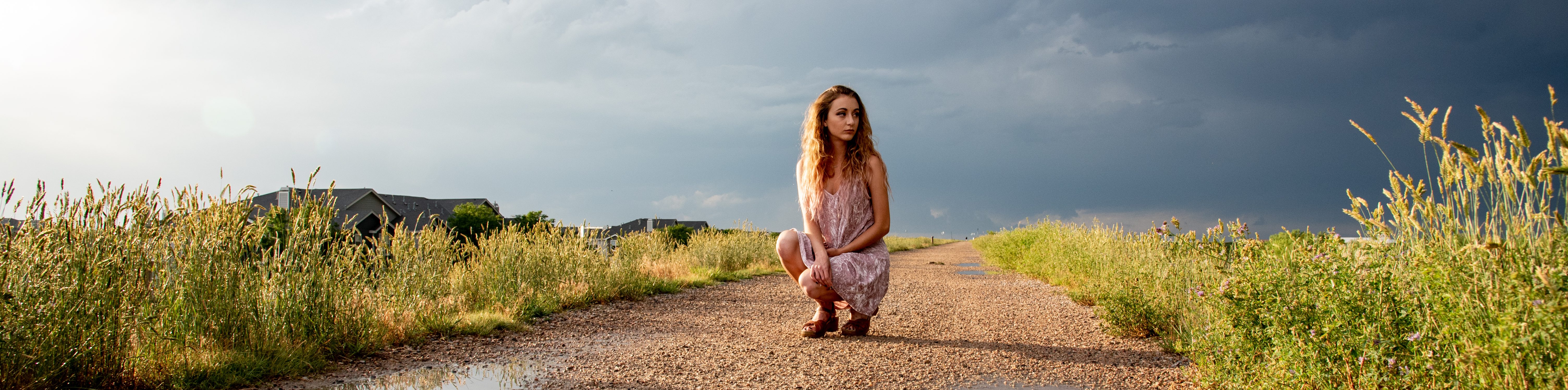
The color pink
My grandfather used to call me Pinky Tuscadero–it was my favorite color since before I can remember. Something about how it could be both soft and urgent. I wasn’t thinking that at four, but as an obnoxious writer I’m thinking it now because it sounds good. It’s true too, though. Soft and urgent. I like that combination.
Being a woman has everything to do with my writing.
My mother was the only daughter of two alcoholics. My grandfather died when I was ten, and my grandmother now lives alone near a river. We played there as kids. We were carefree and showing skin. My mother raised herself. She cared for her two younger brothers, did the family’s laundry–cleaned. My mother needed no one. I need her like my own lungs.
So far, it’s taken me twenty-five years to know my body. It will take twenty-five and twenty-five more. What I am sure of is that I love it–or that I would like to love my body. Because it is soft and urgent.
Public Dream // Frances Leviston
Her writing found me feral in an empty college dorm room. I was starving and alone–both of my own volition–trying to be a writer, or at the very least someone worth knowing. (I was disgustingly dramatic. Probably still am. Fuck it.) I heard her voice before I read her work–this is important. At the time, the voice in my head was both unkind and unwilling. Hers cut through.
I found recordings of readings given at various Ivy leagues schools that could not have been further from SUNY Potsdam. I always thought I was angry at elitism, but I was probably just jealous. Very glad I got over that.
She was the first poet I fell in love with. I’ll include a link to my favorite recording of hers. I often play it when I’m hurting.
https://www.newyorker.com/magazine/2019/05/27/high-force
To After That (Toaf) // Renee Gladman
This book is a love letter to a novella that was never published called “After That.” Renee Gladman has dubbed Toaf, “a true account of a fictional book” and I fell deeply in love with that sentiment. To write a love letter to something that never existed–a eulogy to something that never lived or died–is punk as hell.
The reader is thrown into the story of how this novella was written and rewritten, with almost no context. It is through description of place and time that we riddle out where exactly we are, and how we got there. I both love and resent this about writers–we often start in the middle of things.
I also love and resent our obsession with place. This is probably because I was unable to connect in writing to anything about Boulder until I read Toaf. Renee is deeply rooted in the cities she writes about–so much so that I know the cracks in the sidewalk outside her apartment. She loves the cities where she lives, though she doesn’t always like them. She writes, “That city, that for lack of a better word housed my novella, remained–for the duration of the first draft–faithful to me.” (20) What does it mean for a city to be faithful?
2007 Youtube
There’s so much sincerity in the videos first posted to Youtube. When the website first emerged in 2007, this new video sharing platform was an opportunity for everyone–there were virtually no barriers to entry. People would just speak into cameras, without concern as to who was watching, earnestly about their lives. The beginning of Youtube was, in my opinion, magical. I remember watching hour-long videos of people talking–just talking–about their feelings and lives and the events of their days.
This seems dull–it seems boring and useless and self-indulgent–but really, it’s fascinating. It was the most sincere expression of individuality, and the clearest call for connection I’d ever seen. Projecting oneself onto someone else’s computer in the hopes that they’d watch and care feels incredibly human to me. It feels honest to want to be seen and heard–to share oneself in this way.
I think in a world that asks us to detach, being sincere–channeling the earnestness of 2007 youtube–is absolutely punk. This is what I’m doing here.
The Grand Canyon
When I was in the hospital, I tacked a picture of the Grand Canyon to the wall across from my bed. A very kind nurse printed out an incredibly pixelated, black and white photo of this big hole, and gave it to me.
Very nice gesture, really depressing gift. Like a bottle of wine.
I’ve never been to the Grand Canyon but I talk about it like an old war buddy. Making plans to go and see it but never really getting there. Thinking of it fondly. Crumpled old picture in a drawer somewhere.
I like having attainable dreams. Going to the Grand Canyon isn’t surprising or impossible–it’s something a lot of people do. But I know when I get there, it’ll mean something. It has already changed me. I want to look into this giant hole and feel very small and unimportant and in absolute awe. I want to be standing next to the person I love. I want to cry.
I write often about the Grand Canyon–how I want to go, or what it means to me. But more so, it informs the way I write. This attainable dream has kept me going–kept me writing–for longer than I care to admit. It means something to me. It makes me hopeful.
Katie Lee
There’s a famous environmental activist, writer, and folk singer named Katie Lee who, as a young woman, explored a place named Glen Canyon.
Katie and two friends, both men–one a photographer, the other a geographer–spent weeks here, having found Glen Canyon on a trip down the Colorado River. Katie describes this time in her life as the most alive she has ever felt–that she had found something worth living for.
I’ve watched recent interviews where she attempts to describe the beauty of this place, and she always ends them in tears. She was in love, absolutely, with this place. With this time in her life.
Glen Canyon was flooded after the construction of the Glen Canyon dam in 1966, and Katie lost her Canyon under twenty feet of the Colorado river. She has never stopped fighting for its return. I take her determination as inspiration.
I wrote this for me, but I hope it was okay.
I love you so much ya know.
x. Allison

 Girl Seeking Peanut Butter